When chemicals fail and mechanical scraping is too slow, pressurised water becomes the universal solvent of heavy industry. Industrial hydroblasting services use water jets at 200 to 2,800 bar to descale heat exchangers, clean storage tanks, prepare surfaces before painting and remove the most stubborn deposits in oil and gas, power, manufacturing and food plants. This guide explains the pressure classes, the equipment, the safety framework and the use cases that matter in African refineries, mines and process plants.
Key takeaways
- Hydroblasting covers four pressure ranges, from low-pressure cleaning (under 200 bar) to ultra-high-pressure cutting and descaling (above 2,000 bar). The choice of class is dictated by the deposit, the substrate and the safety envelope.
- Typical applications include heat exchanger descaling, pipeline cleaning, tank desludging, surface preparation before coating, marine hull cleaning and emergency spill response.
- Hydroblasting is the most kinetically dangerous cleaning method: WJTA standards, certified operators, automated lance manipulators and rigorous exclusion zones are non-negotiable.
- Modern UHP equipment, rotating nozzles and robotic crawlers cut cleaning times by half and reduce operator exposure, but require trained crews and quality water supply.
What hydroblasting actually is
Hydroblasting is the use of water - sometimes mixed with abrasive grit - propelled by a high-pressure pump through a controlled nozzle to remove deposits, coatings or contaminants from a surface. The cleaning action comes purely from the kinetic energy of the water jet, not from chemistry. It is one of the five method families described in our industrial cleaning services pillar, and the dominant choice when chemicals are forbidden (food contact, certain stainless steel grades), when deposits are too hard for chemistry (mineral scale, polymer build-up, hardened coke), or when the asset cannot be disassembled (large heat exchangers, storage tanks, long pipelines).
Pressure classes and what each does
| Class |
Pressure range |
Typical work |
Operator profile |
| LP - Low pressure |
Under 200 bar |
General washdown, floors, exterior of equipment |
Trained operator, standard PPE |
| HP - High pressure |
200 to 1,000 bar |
Light scale, paint preparation, vehicle washing |
Certified operator, water-resistant PPE |
| HHP - Hyper high pressure |
1,000 to 2,000 bar |
Heat exchangers, tubes, pipelines, coatings |
Certified WJTA operator, full protective suit |
| UHP - Ultra high pressure |
2,000 to 2,800 bar and above |
Hardened deposits, concrete demolition, cutting |
Senior certified crew, dump system, exclusion zone |
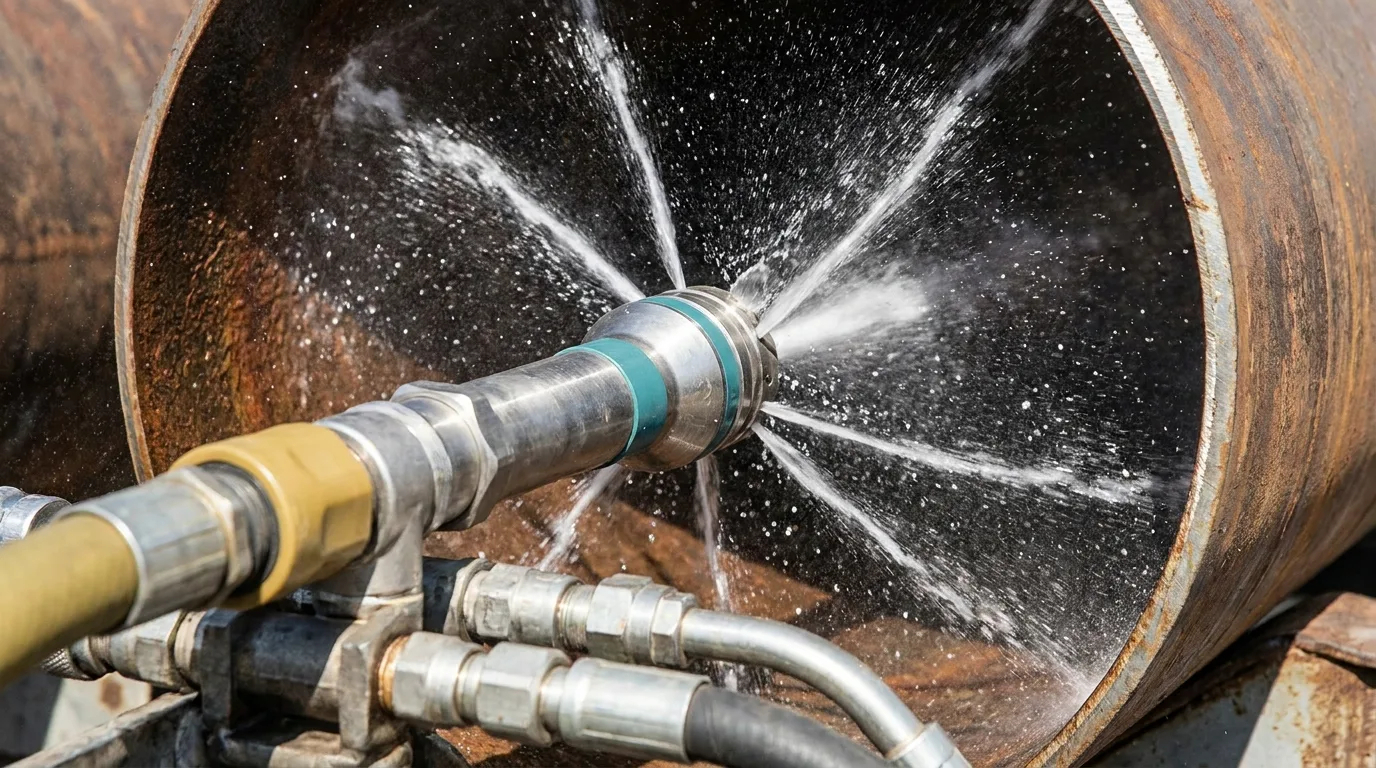
A rotating UHP nozzle generates a 360-degree cleaning pattern that scours pipe internals without operator intervention.
Typical applications across African industries
Heat exchanger and condenser cleaning
Tube bundles foul progressively with mineral scale, polymer build-up and biofilm. A 10 to 20% drop in heat transfer efficiency justifies hydroblasting before chemical descaling is attempted. Automated lance manipulators feed flexible lances into each tube at a controlled pace, producing repeatable results and removing the operator from the line of fire.
Tank, vessel and confined space cleaning
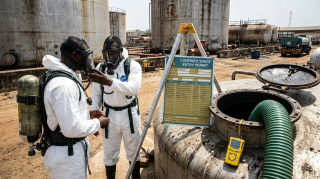
Hydrocarbon storage tanks, chemical reactors and feed silos accumulate sludge, polymerised products and corrosion deposits. Hydroblasting from outside through manhole openings, or from inside using robotic crawlers, removes these residues without sending personnel into hazardous atmospheres. The full safety framework for these operations is covered in industrial tank cleaning services .
Pipeline and process line cleaning
Effluent lines, drainage pipes and process pipelines are cleaned by inserting rotating nozzles, sometimes mounted on self-propelled units, that scour deposits along the length of the pipe. Hydroblasting often complements pigging operations on long-distance pipelines.
Surface preparation before painting or coating
NACE and SSPC standards (WJ-1 to WJ-4) define the surface cleanliness achievable by UHP water jetting before applying protective coatings. UHP water replaces sandblasting in environments where dust is a nuisance, such as occupied refineries or food plants.
Concrete renovation and demolition
UHP hydrodemolition removes deteriorated concrete from bridges, tanks and floors without damaging the rebar. It is now the standard method for civil renovation of large industrial infrastructure.
Equipment and recent technological advances
A hydroblasting setup combines a high-pressure plunger pump (diesel or electric, 100 to 1,500 kW), heavy-duty hoses rated to the working pressure, a hand-held or manipulated lance with interchangeable nozzles, and a dump system that depressurises the line when the dead-man trigger is released.
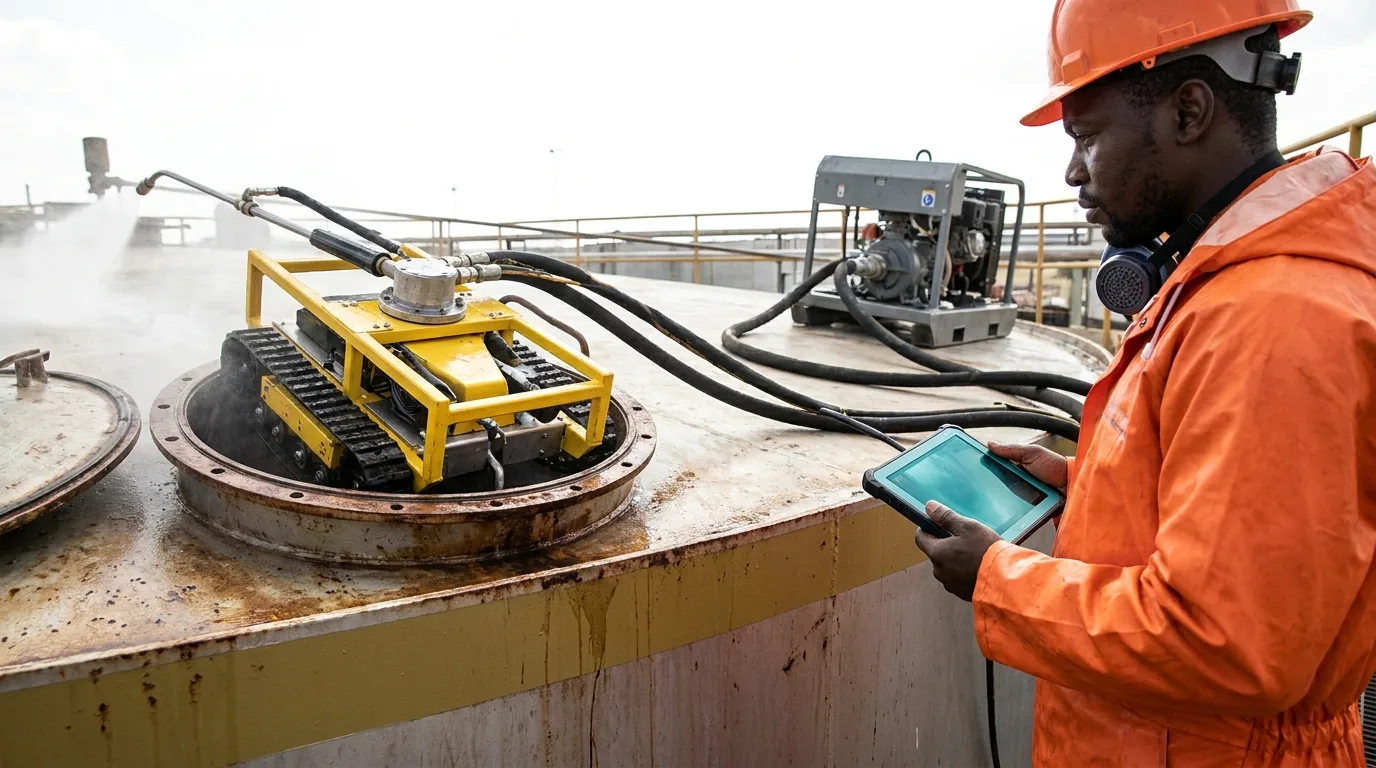
Robotic crawlers and lance manipulators remove the operator from the line of fire while maintaining cleaning quality.
The major shift of the past five years is the move from manual lances to automated and robotic systems. Automated lance manipulators feed rigid or flexible lances into tubes and pipes at a fixed speed. Robotic tank cleaners (magnetic crawlers, lance-arm robots) operate inside tanks while the supervisor stays outside. These solutions cut cleaning time, eliminate ergonomic strain and dramatically reduce the risk of a kickback or jet impact accident.
Safety: the discipline that makes the trade
Hydroblasting is the cleaning method with the highest kinetic energy and therefore the highest accident severity. A 700 bar jet can cut through skin, muscle and bone in milliseconds. The WJTA (Water Jet Technology Association) recommended practices are the international reference and include:
-
Certified operators only, with documented training, refresher every 2 years.
-
Two-hand dead-man controls on every lance, with immediate dump valves.
-
Exclusion zones of 15 to 25 metres around the active jet, marked and supervised.
-
Full PPE: rigid waterproof suit, helmet with face shield, ear protection, gloves rated to working pressure, dielectric boots.
-
Toolbox talks at every shift start, JSA (Job Safety Analysis) signed off before each new job.
-
Robotic substitution wherever the geometry allows.
Hydroblasting versus chemical cleaning
Hydroblasting and chemistry are complementary, not exclusive. Chemistry shines where deposits are soluble and the substrate tolerates contact time (CIP loops, light mineral scale, organic build-up). Hydroblasting shines where deposits are hard, where chemistry would damage the substrate or where downstream effluent treatment makes chemicals undesirable. Many real-world descaling jobs combine a short chemical soak followed by hydroblasting, doubling the result and halving the time. The chemistry side of the equation is detailed in our industrial chemical cleaning guide.
Water management and sustainability
Hydroblasting consumes 50 to 500 litres of water per minute depending on pressure. On large jobs (refineries, mines, power plants), water sourcing, containment and treatment become operational bottlenecks in their own right. Modern providers deploy closed-loop systems that recycle 70 to 90% of the spent water through filtration and oil-water separation, dramatically reducing fresh water draw and effluent volume. These approaches feed into the broader ESG agenda explored in sustainable industrial cleaning .
Frequently asked questions
Is hydroblasting safe to use near electrical equipment?
Yes, with strict precautions: isolation and lockout of the panels, dielectric PPE, exclusion zones, and use of demineralised water below a defined conductivity threshold. For electrical equipment that cannot be isolated, dry methods like dry ice blasting are usually preferred.
What pressure should I use to clean a heat exchanger?
Mineral scale in heat exchanger tubes typically requires 700 to 1,400 bar. Hard polymer or coke deposits may need 1,500 to 2,500 bar. The right pressure is determined by a sample test on a single tube before scaling up to the full bundle.
Can hydroblasting replace sandblasting for surface preparation?
Often yes. UHP water jetting at 2,000 to 2,800 bar achieves NACE WJ-2 to WJ-1 cleanliness without dust, without grit waste and without damaging the substrate profile. It is the preferred method in working refineries, food plants and any environment where airborne grit is unacceptable.
What certifications should a hydroblasting contractor hold?
Look for ISO 9001/14001/45001, WJTA-certified operators, operator-level training cards (typically renewed every 24 months), and a documented safety record (LTIFR, near-miss reporting). For pipework integrity, NACE or AMPP credentials are an asset.
How does hydroblasting fit in a wider cleaning programme?
It is one of five method families that work together. The full panorama, plus the selection criteria for combining hydroblasting with chemistry, dry methods or mechanical cleaning, is laid out in our industrial cleaning services pillar guide .