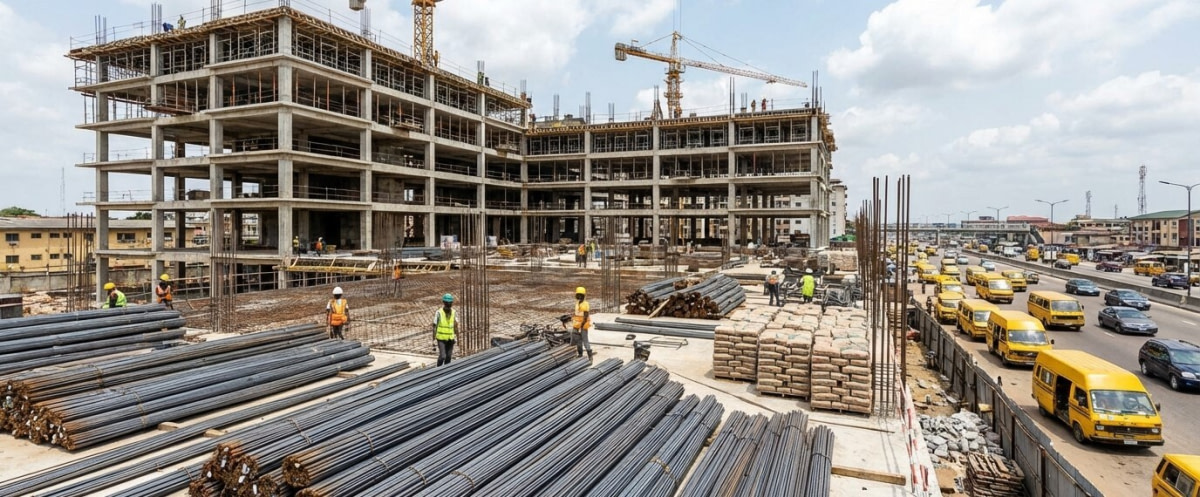
In Nigeria, building budgets no longer move in straight lines. A project that looked realistic a few months ago can suddenly become harder to price, harder to fund and harder to deliver. As the cost of cement, steel, roofing materials, finishes and site logistics continues to rise, developers, contractors and private clients are being pushed to rethink how projects are planned and executed.
This shift is affecting far more than procurement. It is changing design decisions, contract negotiations, delivery timelines and the overall structure of many developments. For anyone involved in construction in Nigeria , rising material prices are no longer just a market inconvenience. They are now one of the main forces shaping what gets built, how it gets built and how quickly it moves.
Pricing a project has become far less predictable
One of the biggest challenges in today’s market is uncertainty. Cost planning used to rely on a reasonable level of predictability between early estimates and actual procurement. That gap has become much harder to manage.
A quotation prepared at the beginning of a project may no longer reflect market reality by the time the contractor is ready to buy materials. This creates pressure on everyone involved. Clients want cost clarity. Contractors need room to protect themselves from sudden increases. Consultants are forced to review numbers more often than before.
Across the Nigerian construction sector, this has made budgeting more dynamic and far less static than it used to be.
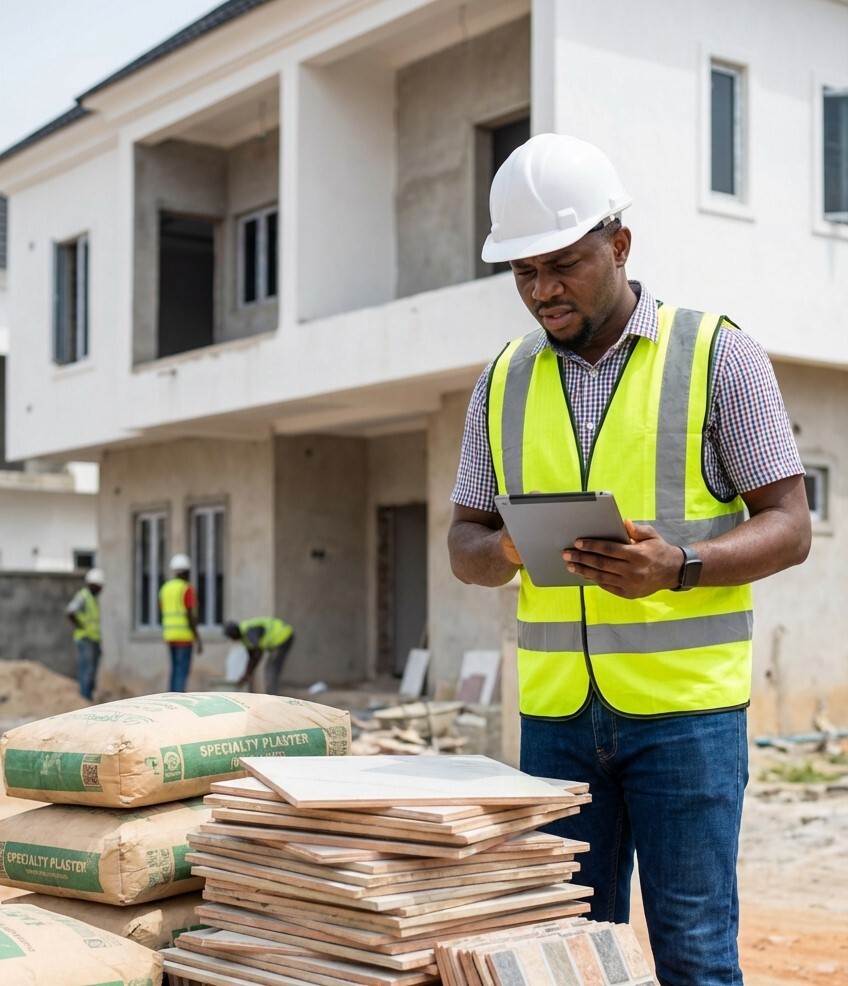
Un ingénieur, tablette à la main, analyse les coûts sur un chantier résidentiel moderne à Abuja. L'inflation galopante des matériaux comme le plâtre et les carrelages oblige les professionnels à une gestion budgétaire rigoureuse et à des réajustements constants des projets.
Cement and steel continue to drive major cost pressure
Few items influence a project as strongly as cement and reinforcement steel. These materials sit at the core of structural work, so any increase in their price has an immediate effect on the total cost of delivery.
For a residential build, that may mean a more expensive foundation, frame and block work package. For larger developments, the impact becomes even more pronounced because the quantities involved are much higher. A relatively small shift in unit price can create a major difference once multiplied across a full site.
This is one reason many builders in Nigeria have become more cautious with long-term price commitments. Holding a fixed figure in a volatile market has become much riskier than it once was.
Imported products make cost control even more difficult
Many projects in Nigeria still depend partly on imported materials or components. Premium tiles, sanitary fittings, specialised hardware, lighting systems, kitchen accessories, aluminium elements and some finishing products are all vulnerable to exchange rate pressure and freight-related cost increases.
This adds another layer of instability. Even where structural costs are manageable, interior and finishing packages can quickly rise beyond what was originally expected. That is especially true on higher-end developments where clients want imported specifications or branded systems.
As a result, many project teams now encourage earlier decisions on finishes, simpler specifications where appropriate, and a closer look at strong local substitutes.
Design is becoming more cost-conscious from the start
Rising prices are changing more than procurement strategy. They are also influencing the way projects are designed.
A client who initially planned a more elaborate structure may now prefer a cleaner layout, a more efficient roof form or a smaller overall footprint. A developer may reduce complexity in order to protect viability. A contractor may advise phasing the work rather than taking on the whole scheme at once.
This does not automatically mean lower quality. In many cases, it leads to smarter and more disciplined choices. Architects, engineers and contractors are under growing pressure to align ambition with financial reality much earlier in the process.
That shift is becoming increasingly visible across the building industry in Nigeria.
Delays on site are becoming more common
When materials become harder to price, projects often slow down. Some clients pause to raise extra funds. Others hold back on bulk purchases in the hope that prices may stabilise. Contractors may also need to revisit procurement schedules or adjust delivery sequencing.
These interruptions rarely affect just one part of the project. Once the timeline begins to stretch, labour planning, subcontractor coordination and site efficiency all come under pressure. A stop-start job usually ends up costing more than one that moves steadily from one phase to the next.
For that reason, many construction companies in Nigeria are encouraging clients to secure key materials earlier, especially for structural works and major finishing items.
Contracts are under more pressure than before
Another visible change can be seen in the way jobs are priced and negotiated. Clients naturally want certainty. Contractors, however, are increasingly careful about promising figures that may no longer be realistic a few months later.
This is affecting how quotations are prepared and how contracts are discussed. Validity periods may be shorter. Material fluctuation clauses have become more relevant. Some firms now separate labour pricing from material pricing more clearly so clients can see where the real risk lies.
In the current Nigeria construction market, that kind of transparency matters more than ever. It reduces misunderstandings and helps both sides make more informed decisions.
Local sourcing is attracting more serious attention
As imported materials become more expensive, local sourcing is receiving more practical consideration. Nigerian-made products are entering more conversations, not only because of cost, but because of availability, replacement and maintenance.
Doors, blocks, metal works, certain finishing products and furniture elements produced locally may not always have the same image as imported alternatives, but they often offer better access, shorter lead times and less exposure to currency-driven price swings.
This does not mean every project should shift fully to local materials. It means the market is becoming more pragmatic. Clients and contractors are increasingly focused on what can be delivered reliably, maintained easily and priced more sustainably over time.
Different clients are responding in different ways
The reaction to rising prices depends heavily on the type of client involved.
A private homeowner may reduce the size of the project, build in phases or switch to more practical materials. A commercial developer may redesign parts of the scheme, renegotiate supplier arrangements or revise selling prices to maintain profitability. An investor may decide to postpone part of the work and focus only on the most commercially urgent phase.
What all these responses have in common is the need for stronger planning. Projects with weak cost control are now far more exposed. Schemes backed by realistic budgeting, clearer procurement planning and regular review meetings stand a better chance of staying on course.
That is why experienced firms are placing much more emphasis on early cost analysis and ongoing financial monitoring.
The pressure is reshaping the industry as a whole
Rising material prices in Nigeria are not just making projects more expensive. They are changing the way the industry operates.
Budgeting is more sensitive. Procurement is more strategic. Design teams are working more closely with cost realities. Contractors are more careful with commitments. Clients are asking sharper questions earlier in the process.
This is creating a more demanding environment, but also a more disciplined one. Assumptions are being tested earlier. Waste is receiving more attention. Material choices are being questioned more seriously. In some cases, that is leading to better project control, even if the financial pressure remains intense.
Stronger planning is now essential
In a market like this, a project cannot rely on rough assumptions. It needs clear numbers, regular reviews and faster decision-making.
That means tracking price movements closely, reviewing specifications before they become too expensive, identifying priority items early and keeping procurement aligned with cash flow. It also means avoiding late design changes that add cost when the project is already under pressure.
For teams working on projects in Nigeria, success now depends as much on financial discipline as on technical delivery.
A new reality for building in Nigeria
The cost of delivering a project in Nigeria can no longer be treated as a fixed figure that stays stable from concept to completion. Material volatility has changed that. Developers, builders, consultants and private clients are all being forced to work with a more fluid and more demanding reality.
Across residential, commercial and mixed-use developments, rising prices are pushing the market toward a different model — one shaped less by assumptions and more by constant adjustment. In today’s environment, the projects that move forward most successfully are usually the ones that stay realistic, respond early and keep tight control over both scope and cost.