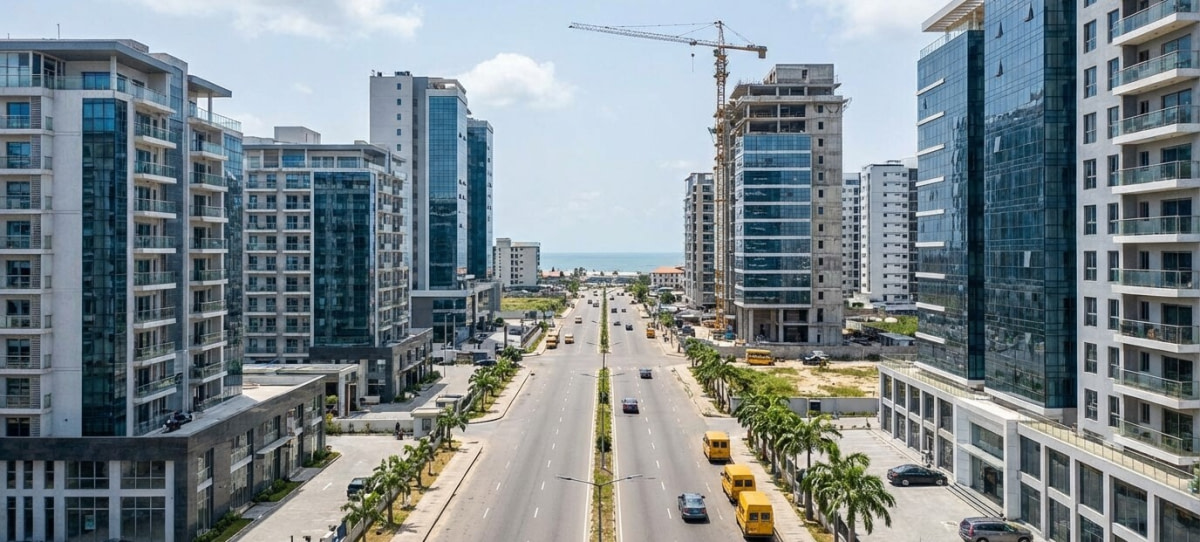
Nigeria’s real estate market is still full of opportunity, but it is no longer a market where broad optimism is enough. In 2026, buyers and investors need to read the landscape more carefully. Demand is still deep, cities are still expanding, and property remains attractive as a long-term asset. But affordability pressure, cost inflation and uneven execution are changing what really works. Official figures show that real estate services grew 3.43% year on year in Q4 2025, while the Federal Ministry of Housing and Urban Development has also highlighted the scale and economic weight of the sector.
The better question this year is not whether property in Nigeria still has potential. It does. The more useful question is where the pressure is building, which segments are holding up best, and what smart buyers should be watching before committing capital. A market can grow and still punish weak assumptions. That is exactly why 2026 calls for more selectivity, more due diligence and fewer lazy decisions.
Housing demand is still strong, but the market is not equally deep at every price point
One of the clearest reasons the sector remains important is the simple fact that Nigeria still has a major housing gap. In January 2026, the Federal Ministry of Housing’s technical committee said the country’s 2025 housing deficit stood at 14.925 million units. That kind of shortage keeps demand alive across multiple segments of the market and continues to support long-term interest in housing delivery.
But demand on paper is not the same as demand that closes transactions. That distinction matters more in 2026. Projects that match real household purchasing power are likely to perform more steadily than schemes priced well above what local buyers can carry. In other words, the market is active, but it is also filtering harder. Developers and investors who understand that difference are more likely to make better decisions.

In-depth market data analysis is crucial for investors. Here, professionals in Abuja examine the growth forecasts for the Nigerian real estate market in 2026.
Affordability is becoming one of the biggest market filters
A lot of buyers are still interested in real estate in Nigeria, but affordability is now doing more of the sorting. High interest rates, income pressure and tighter liquidity mean many people who want to buy are taking longer to act. This is one reason payment plans, phased delivery and better-sized products are becoming more relevant than before.
That pressure fits the broader economic picture. Nigeria’s economy grew 3.87% in 2025, which is encouraging, but growth alone does not remove financing stress from the market. In practice, this means buyers are comparing harder, delaying more, and looking more closely at what they can truly sustain over time. In 2026, affordability is not a side issue. It is one of the main forces shaping demand.
Infrastructure is still one of the biggest signals for future value
Infrastructure continues to shape where the next wave of property value may emerge. Reporting tied to Knight Frank’s Lagos Market Update H2 2025 highlighted the impact of public infrastructure corridors, urban renewal and stronger construction activity on market performance and investment interest.
That matters because buyers who focus only on traditional prime areas can miss medium-term value in corridors benefiting from improved access and new connectivity. In markets like Lagos especially, infrastructure often changes the logic of land value faster than many buyers expect. In 2026, investors should be watching not just prestige locations, but also where roads, transport links and public investment are quietly reshaping the map.
Another trend worth taking seriously is the stronger case for mixed-use and income-generating formats. Knight Frank’s Lagos market reporting points to a market where integrated developments and more flexible commercial formats are gaining relevance. That is a meaningful signal in a market where occupiers and investors are both becoming more selective.
For buyers and investors, this means simple speculation may no longer be enough in every location. Assets with clearer rental logic, practical use cases and stronger day-to-day relevance may prove more resilient than projects relying mainly on future appreciation. In 2026, the smartest capital is likely to move toward property that can justify itself operationally, not just emotionally.
Construction cost pressure is still shaping the market
Even where demand looks healthy, construction costs in Nigeria remain one of the biggest variables behind pricing decisions. Cement, steel, imported finishes, logistics and exchange-rate-related procurement pressure continue to affect project viability. That does not only influence new launches. It also affects delivery speed, pricing strategy and how much risk a developer can absorb before margins start to narrow.
For buyers, that means cheaper property is not automatically better value. A low headline price may hide quality compromise, delivery delays or weak execution. For investors, it makes developer credibility far more important. In a market where cost pressure still matters, build quality, delivery discipline and financial realism carry more weight than marketing language. Knight Frank’s market commentary also points to stronger construction activity in late 2025, but not to a market free from cost discipline.
Capital is returning, but not all inflows mean long-term real estate confidence
There is another detail investors should not overlook. Reuters reported in March 2026 that Nigeria’s capital inflows jumped 90% in 2025, but that increase was driven overwhelmingly by foreign portfolio investment, while foreign direct investment rose only modestly. That is an important distinction. It shows that investor appetite for Nigeria has improved, but a large share of that capital is still short-term in nature.
For property investors, the lesson is simple: broad macro optimism should not replace asset-level analysis. A strong headline on inflows does not automatically make every development safer or every land play smarter. In 2026, serious buyers still need to focus on title quality, infrastructure, rental demand, developer track record and the depth of real end-user demand.
What buyers and investors should really watch in 2026
The strongest opportunities this year are likely to sit where several things come together at once: realistic pricing, clear demand, improving infrastructure, sensible design and credible delivery. Buyers should watch affordability because it will continue to determine who can actually transact. Investors should watch infrastructure-led locations, because those areas may produce some of the best medium-term upside. Both should watch developer discipline, because execution risk matters more when build costs are still under pressure.
The Nigerian property story is still compelling, but it is maturing. That is what makes 2026 different. The market still offers opportunity, but it rewards the people who study it properly. The winners this year are less likely to be the loudest buyers in the room, and more likely to be the ones who understand where demand is real, where value is moving, and where risk is hiding in plain sight.