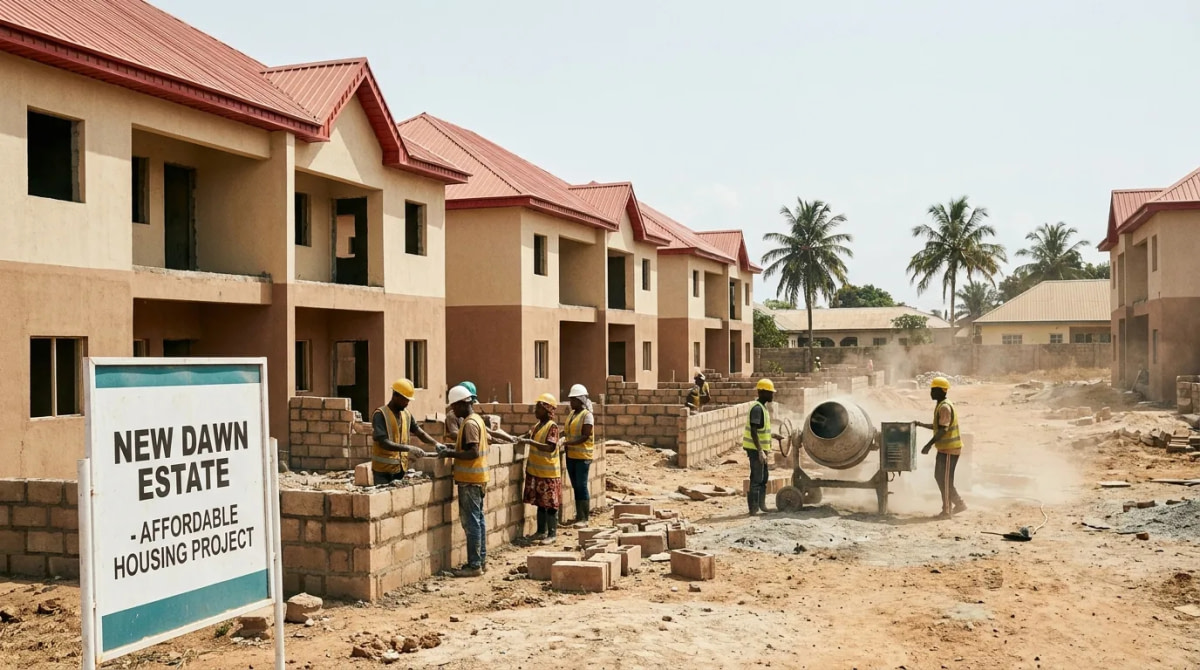
With a housing deficit estimated at more than 28 million units and a population set to exceed 230 million, affordable housing in Nigeria sits at the intersection of social urgency, public policy and private investment. This guide unpacks the demand drivers, construction costs, government schemes and concrete opportunities shaping Nigeria's low-cost housing market in 2026.
Key takeaways
- Nigeria's housing deficit stands at 28 million units in 2026, with annual demand exceeding 700,000 new homes against actual delivery below 100,000.
- The three biggest brakes on supply are land tenure complexity under the Land Use Act, soaring construction costs (cement, rebar, labour) and a mortgage market worth less than 1% of GDP.
- Federal programmes (Federal Mortgage Bank of Nigeria, Family Homes Funds, Renewed Hope Cities) and state initiatives in Lagos, FCT, Ogun, Rivers and Kano are driving the pipeline of low-cost units.
- For developers and investors, the most resilient business models combine off-taker agreements with public agencies, alternative building materials and tight cost engineering.
Understanding Nigeria's affordable housing market
Defining "affordable" housing in Nigeria
In Nigeria, affordable housing is broadly defined as residential units that a household can purchase or rent while spending no more than 30% of its monthly income on housing. Translated into 2026 prices, this typically means one- to three-bedroom homes priced between 8 and 25 million naira, or monthly rents of 100,000 to 300,000 naira in major urban centres. The exact threshold varies by state, by income bracket and by whether the buyer benefits from a National Housing Fund (NHF) mortgage.
The scale of the housing deficit in Nigeria
The Federal Ministry of Housing and Urban Development and the World Bank converge on a housing deficit in Nigeria of around 28 million units. The annual organic demand, driven by urbanisation, family formation and replacement of dilapidated stock, exceeds 700,000 homes per year. Actual delivery, however, hovers below 100,000 units, leaving a structural gap that grows by more than half a million homes annually.
Demand is concentrated in Lagos, the Federal Capital Territory (FCT), Port Harcourt, Kano and Ibadan, but spreads rapidly to secondary cities such as Abeokuta, Uyo, Enugu and Asaba. The boom in remote work and the relocation of public servants under the Renewed Hope agenda are also reshaping the geography of demand.
Why the housing gap persists in Nigeria
Land tenure and the Land Use Act
The Land Use Act of 1978 vests all land in state governors, who issue Certificates of Occupancy (C of O) for terms of up to 99 years. The C of O perfection process is slow, costly and prone to administrative bottlenecks, which inflates the cost base of any development. In Lagos State alone, the cost of land titling and consent can add 10 to 20% to the final price of an affordable unit.
Soaring construction costs in Nigeria
Construction cost inflation has been the single biggest headwind for developers over the past three years. The price of a 50-kg bag of cement has roughly tripled since 2022, reinforcement bars and roofing sheets have followed similar trajectories, and labour costs have climbed in step with general inflation. Naira devaluation has compounded the issue for any input with imported content, from tiles and sanitary ware to elevators and electrical fittings.
Developers active in real estate development in Nigeria now build cost engineering into their earliest design stages, locking in supply contracts with cement producers (Dangote Cement, BUA Cement, Lafarge Africa) and exploring local substitutes wherever possible.
A shallow mortgage market
Mortgage finance in Nigeria represents less than 1% of GDP, against more than 30% in South Africa and 70% in advanced economies. High interest rates (often above 20% commercially), short tenors and the limited reach of the Federal Mortgage Bank of Nigeria keep ownership out of reach for most households. Without deeper mortgage penetration, even units priced at the right level remain difficult to absorb.
Government programmes driving affordable housing
Federal Mortgage Bank of Nigeria and the National Housing Fund
The Federal Mortgage Bank of Nigeria (FMBN) administers the National Housing Fund (NHF), funded by mandatory 2.5% salary contributions from formal-sector workers. NHF loans of up to 50 million naira are offered at single-digit interest rates over tenors of up to 30 years, making it the most accessible mortgage product for low- and middle-income earners. The bank also funds developers through estate development loans (EDLs) and the Cooperative Housing Development Loan.
Family Homes Funds Limited (FHFL)
Family Homes Funds Limited is the federal social housing investment vehicle. It co-finances large-scale affordable estates in partnership with state governments and private developers, with a stated ambition to deliver 500,000 units and create one million construction jobs. FHFL also runs rent-to-own and equity-contribution schemes targeted at households earning below the national median income.
Renewed Hope Cities and state-level initiatives
Launched under President Bola Tinubu's administration, the Renewed Hope Cities and Estates programme aims to deliver 100,000 housing units across the 36 states and the FCT. At state level, Lagos HOMS, the Rivers State Affordable Housing Scheme, the Ogun Affordable Housing Programme and Kano's Amana City all add to the pipeline. These programmes typically combine subsidised land, infrastructure grants and off-take guarantees to derisk projects for private contractors.
How much does it cost to build affordable housing in Nigeria?
The 2026 construction cost in Nigeria for a finished affordable unit ranges widely depending on location, plot size, finish level and use of local versus imported materials. The table below provides realistic ranges for the most common typologies, excluding land cost.
| Unit type |
Built-up area (sqm) |
Indicative construction cost (NGN) |
Typical buyer profile |
| Studio flat |
30 to 40 |
6 to 9 million |
Single workers, students, young graduates |
| 1-bedroom flat |
40 to 55 |
8 to 12 million |
Young couples, civil servants |
| 2-bedroom bungalow |
70 to 90 |
14 to 22 million |
Small families, NHF-eligible buyers |
| 3-bedroom terrace |
100 to 130 |
22 to 35 million |
Middle-income families |
| 4-bedroom semi-detached |
150 to 200 |
35 to 60 million |
Upper end of the affordable segment |
Land acquisition, titling, infrastructure (roads, drainage, water, power) and developer margin typically add another 30 to 50% on top of the construction cost. In Lagos and Abuja, prime locations push the all-in price well above these averages.
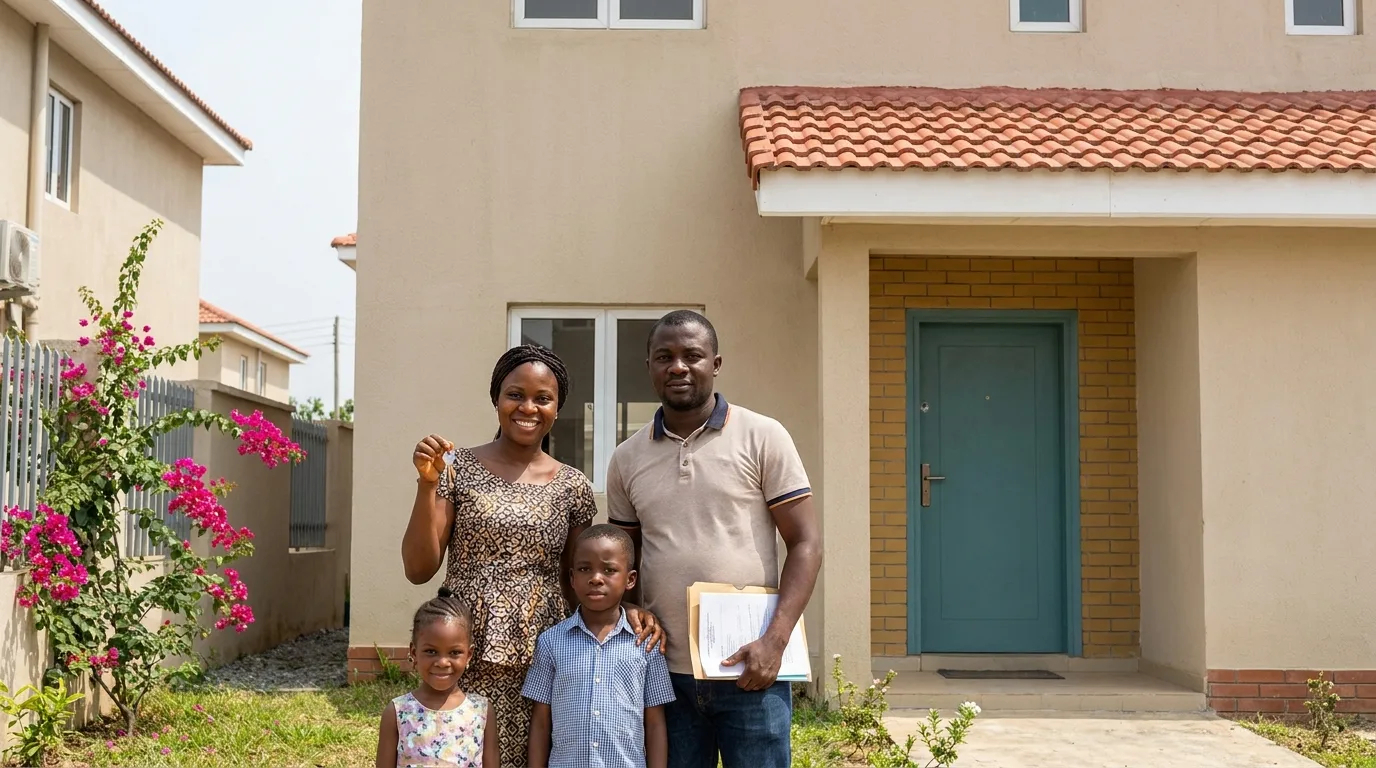
Affordable housing delivery directly reshapes daily life for young Nigerian families.
Construction methods and materials for low cost housing in Nigeria
Sandcrete blocks and the cement question
Sandcrete (cement-sand) blocks remain the dominant building material for residential construction in Nigeria. They are well understood by local contractors, durable in tropical conditions and easy to source. The downside is heavy dependence on cement prices, which makes the final cost of a sandcrete-built home highly volatile.
Compressed earth blocks, bamboo and alternative materials
Stabilised compressed earth blocks (CSEB), interlocking blocks, hydraform technology and bamboo-reinforced concrete are gaining traction on social housing pilots. CSEB units can cut wall costs by 30 to 40% compared to sandcrete while improving thermal performance, but require trained crews and quality control to meet certification standards.
Prefabricated and modular construction
Prefabricated systems (precast concrete panels, light gauge steel frames, container conversions) shorten on-site build times from 9 to 12 months to 3 to 4 months for a similar unit. Several developers in Lagos and Abuja have piloted modular solutions on Renewed Hope sites, with cost parity reached on schemes above 200 units.