Most Nigerians buy property with cash, and for good reason: commercial mortgage rates run well above 20%, and formal home loans fund less than one in two hundred naira of the economy. Yet financing does exist, and the gap between a 6% government-backed loan and a 28% commercial one is enormous. This guide breaks down the real mortgage options in Nigeria in 2026, from the National Housing Fund and MREIF to commercial banks, rent-to-own, non-interest finance and diaspora products, who each suits, what they cost, and how to qualify. All rates and ceilings are indicative and change often, so confirm current terms with the lender.
Key takeaways
- Single-digit mortgage rates in Nigeria come almost only from government-backed schemes: the NHF at 6%, the Diaspora NHF at 9% and MREIF at 9.75%.
- Commercial bank mortgages are far pricier, roughly 18-28%+, because they track the CBN policy rate (near 27%) plus a margin.
- The FMBN raised the maximum NHF loan from N15m to N50m in 2025, widening access for contributors.
- You cannot mortgage bare land, only a completed or under-construction house with a clean, registered title.
- Budget 8-15% of the price for closing and perfection costs on top of your deposit, and expect title perfection to take months.
Why financing property in Nigeria is hard, and where it works

A good adviser will steer you toward the cheapest scheme you actually qualify for, which is rarely a plain commercial mortgage.
Mortgage penetration in Nigeria is about 0.5% of GDP, one of the lowest rates in the world, against a housing deficit estimated at around 28 million units. The reason is simple: unsubsidised loans are priced off the Central Bank Monetary Policy Rate, which sat near 27% through 2025 and 2026, so a plain commercial mortgage cannot fall to single digits. On top of that, over 97% of Nigerian land is not formally titled, which shrinks the pool of properties a lender will accept as security.
That is why the practical question is not just "can I get a home loan in Nigeria", but "which scheme do I qualify for". Government-backed programmes offer dramatically cheaper money than the open market, and knowing the difference is the single biggest lever on what you will pay.
Your mortgage and home loan options compared
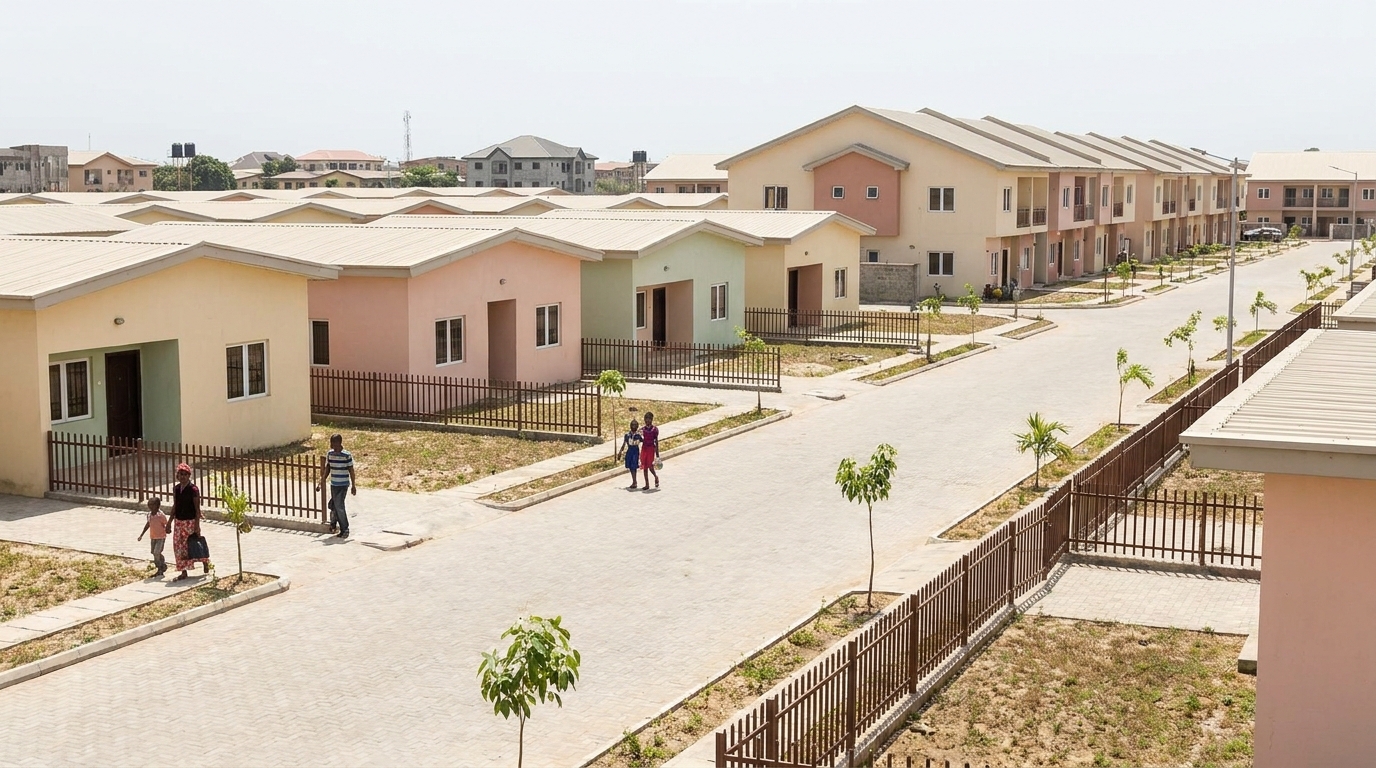
Government schemes such as the NHF, MREIF and Renewed Hope bundle subsidised finance with the homes themselves.
Nigeria's housing finance splits into subsidised government schemes and market-rate commercial products, with a few specialist routes. Here is how the main options compare. All figures are indicative and subject to change.
| Option |
Best for |
Indicative terms (rate / tenure / equity) |
|
NHF mortgage (FMBN, via an accredited PMB) |
Formally employed NHF contributors wanting the lowest cost and able to wait through a slower process |
Fixed 6%; up to 30 years (ends by retirement); max loan raised to N50m; equity tiered (0% up to N5m, then 10-30%) |
| Commercial bank / PMB mortgage |
Salaried or business owners with strong income needing a ready-built home quickly |
~18-28%+, mostly variable; 10-20 years; equity typically 20-30% (higher for self-employed and non-residents) |
|
MREIF (MOFI Real Estate Investment Fund) |
Salaried Nigerians (including eligible diaspora) wanting a below-market fixed rate without NHF membership |
Fixed 9.75%; up to 20 years; from 10% equity; up to ~N100m; salary domiciled 6 months, min salary ~N200,000/month |
| FMBN Rent-to-Own |
NHF contributors who cannot raise a deposit but have steady income |
~7% on an annuity basis; up to 30 years; no upfront equity; property price capped around N15m |
|
State schemes (e.g. LagosHOMS) |
First-time buyers who are long-term residents of the state |
~6%; ~30% equity, bank funds 70%; 10-20 years; residency and income conditions apply |
| Developer / off-plan plan |
Buyers with periodic income who can tolerate risk and do thorough due diligence |
Deposit ~10-30% then milestone installments over 6-24 months; early-bird ~10-40% below finished value; not a mortgage |
| Non-interest (Islamic) finance |
Buyers avoiding conventional interest on faith or ethical grounds |
Ijara, Murabaha or diminishing Musharaka structures via licensed non-interest banks; confirm current products and pricing |
| Cooperative / employer loans |
Active cooperative members and staff whose employer facilitates salary-deducted loans |
Often well below commercial (from ~6-8.5% once savings mature); repaid by salary deduction; smaller maximum amounts |
|
Diaspora mortgage (FMBN Diaspora NHF or commercial) |
Nigerians abroad buying or building back home |
Diaspora NHF 9%, 30% equity, up to N50m; commercial diaspora naira loans far higher (~20-28%); Non-Resident BVN enables remote onboarding |
Who qualifies for a home loan in Nigeria
Requirements vary by product, but lenders converge on a common core:
-
Citizenship and age: Nigerian, with the loan structured so repayment ends by the retirement age of about 60, which caps the tenure by your age.
-
Verifiable income: monthly repayment is generally capped near one-third of income under the NHF norm, and up to about 40% on some commercial products.
-
NHF loans: at least six months of NHF contributions (2.5% of basic salary), no prior NHF default, and application through an accredited Primary Mortgage Bank, never directly to FMBN.
-
An equity contribution: NHF is tiered (0% up to N5m, then 10-30%), MREIF from 10%, commercial banks typically 20-50%, and Diaspora NHF 30%.
-
A clean, registered title: a Certificate of Occupancy or registered Deed of Assignment with Governor's Consent, free of encumbrances. A defective title is the most common reason for rejection.
-
Documentation: salaried applicants usually need 6-12 months of bank statements and an employer letter; the self-employed need 2-3 years of business history, audited accounts, CAC registration and tax clearance.
How a mortgage application works, step by step
-
Find and verify the property: inspect it and run title due diligence at the state Land Registry to confirm ownership and check for encumbrances.
-
Get pre-qualified: the lender assesses your age and net income against the affordability rule that repayment stays near a third of income.
-
Apply with documents: submit ID, bank statements, employer or business records, the property offer letter and title documents to an accredited PMB or bank.
-
Verification and valuation: the lender runs a credit-bureau check and appraises the property.
-
Offer letter: review and accept the lender's offer within its response window.
-
Pay your equity: contribute the required down payment into the transaction.
-
Perfect the mortgage: obtain Governor's Consent, then stamp and register the mortgage at the Land Registry.
-
Disbursement: the lender pays the seller or developer, and repayment begins.
Costs and challenges to plan for
-
Closing costs: total upfront costs typically run 8-15% of the price (as low as ~4% with a clean title), on top of your deposit. On a N50m home that is roughly N4-7.5m.
-
Government perfection fees: in Lagos these total around 3% of assessed value (Governor's Consent ~1.5%, plus capital gains tax, stamp duty and registration).
-
Professional fees: a conveyancing lawyer (~0.5-1.5%), valuation (~0.25-1%) and agency commission (commonly 5-10%).
-
High rates and inflation: commercial rates near or above 20%, combined with double-digit inflation and high price-to-income ratios, price most middle-income households out.
-
Title bottlenecks: with over 97% of land untitled, few properties qualify as collateral, and land alone cannot be mortgaged, only a completed or under-construction house.
-
Slow perfection: Governor's Consent typically takes 3-4 months and can stretch to a year in some states.
-
Off-plan risk: construction delays, developer insolvency, defective title and asymmetric penalty clauses that punish a late buyer but not a late developer.
How to choose the right option for you
-
Employed NHF contributor on a budget: prioritise the NHF mortgage at 6%, or FMBN Rent-to-Own at ~7% if you cannot raise a deposit.
-
Salaried, no NHF membership: consider MREIF at 9.75% through a partner bank, mindful of the salary-domiciliation and minimum-income conditions.
-
Strong income, need to move fast: a commercial bank or PMB mortgage is the most available route, but budget for a high variable rate and larger equity.
-
Avoiding interest: use a licensed non-interest bank offering Ijara, Murabaha or diminishing Musharaka.
-
Nigerian abroad: weigh the Diaspora NHF (9%, 30% equity) against commercial diaspora products or MREIF, using the Non-Resident BVN to apply remotely.
-
Always compare total cost, not headline rate: factor in tenure, equity and 8-15% closing costs, and confirm current figures directly with the lender.
Verify the title before you borrow
No lender will fund a property on a bad title, and neither should you buy one. A clean, registered Certificate of Occupancy or a Deed of Assignment carrying Governor's Consent, free of encumbrances, is a strict prerequisite for approval, and confirming it protects you from the losses that sink so many purchases. For the full method, see our guide to property title verification in Nigeria , and learn the warning signs in buying property in Nigeria without getting scammed .
Frequently asked questions
What is the cheapest mortgage available in Nigeria?
The National Housing Fund (NHF) mortgage, administered by FMBN through accredited Primary Mortgage Banks, is the cheapest conventional route at a fixed 6% per annum over up to 30 years. The next cheapest options are also government-backed: the Diaspora NHF at 9% and MREIF at 9.75%. These rates are indicative and subject to change.
Why are commercial bank mortgage rates in Nigeria so high?
Commercial mortgages, roughly 18-28%+ per annum, are mostly variable and priced off the CBN Monetary Policy Rate plus a risk margin. The policy rate was 27.5% for most of 2025 and 27% into 2026, so unsubsidised rates cannot reach single digits while the benchmark is that high. Only government-subsidised schemes offer single-digit rates.
Can I apply to FMBN directly for an NHF loan?
No. Individuals cannot apply directly to FMBN. You must apply through a licensed and accredited Primary Mortgage Bank, which packages and forwards your application to FMBN. You also need at least six months of NHF contributions (2.5% of basic salary) and verifiable income.
How much deposit do I need to buy with a mortgage?
It depends on the scheme. The NHF is tiered by loan band (0% up to N5m, then 10%, 20%, up to 30% on the largest loans). MREIF starts at 10%. Commercial banks and PMBs typically require 20-50%, commonly 20-30% for residents, and the Diaspora NHF requires 30%. These figures are indicative and subject to change.
Can I use a mortgage to buy land or an off-plan property?
You cannot buy bare land with a mortgage; only completed or under-construction houses qualify. Off-plan units can be financed by some lenders, usually at higher equity, but are excluded by MREIF, which covers only completed, registered-title properties. Off-plan purchases also carry delivery and title risk, so verify the title and the developer carefully.
Can Nigerians living abroad get a mortgage to buy property back home?
Yes. The FMBN Diaspora NHF Mortgage lets you register, contribute and borrow (9% rate, 30% equity, up to N50m) without travelling home. Several commercial banks also offer diaspora products with no NHF requirement, and MREIF is open to eligible diaspora buyers. The Non-Resident BVN, launched in 2025, lets you complete much of the application online, though title verification and closing usually still need a local representative.