Key takeaways
- Food plant cleaning is a regulated control step under HACCP, ISO 22000, FSSC 22000 and national authorities (NAFDAC in Nigeria, FDA in Ghana, KEBS in Kenya, SAHPRA in South Africa).
- A robust programme combines food-grade chemicals (alkaline, acid, sanitizers), a documented master sanitation schedule, allergen segregation and a verification plan (visual, ATP, microbiological).
- Color-coded tools, validated CIP loops and trained operators are the three operational pillars that separate compliant plants from at-risk ones.
- Sustainable practices (water reuse, biodegradable detergents, enzymatic cleaners) increasingly drive procurement decisions in food multinationals operating in Africa.
The hidden cost of imperfect food plant cleaning
A single missed cleaning step can wipe out months of margin: contaminated batches, mandatory recall, regulatory fines, loss of certification, brand crisis on social media. In Africa, where national authorities are tightening enforcement and where international clients audit their suppliers more aggressively, the gap between adequate and excellent sanitation translates directly into commercial survival.
This is why food industry cleaning services have moved away from generic janitorial offers toward a specialised, validated, documented practice that is best understood within the broader industrial cleaning services discipline.
The regulatory framework
HACCP, ISO 22000 and FSSC 22000
HACCP (Hazard Analysis and Critical Control Points) is the international foundation: identify hazards, set critical control points, monitor, correct, verify. ISO 22000 wraps HACCP into a full food safety management system, and FSSC 22000 adds the prerequisite programmes (PRPs) required by the Global Food Safety Initiative (GFSI). Cleaning sits as a major PRP that supports every CCP downstream.
National food safety authorities
NAFDAC in Nigeria, the Food and Drugs Authority in Ghana, KEBS in Kenya, SAHPRA and the National Regulator for Compulsory Specifications in South Africa enforce hygiene rules in factories, inspect premises and can suspend production permits. Most large food groups operating in Africa now add their internal corporate standards (Nestle, Unilever, Coca-Cola, Diageo, Promasidor) on top of these.
The seven steps of a food plant cleaning cycle
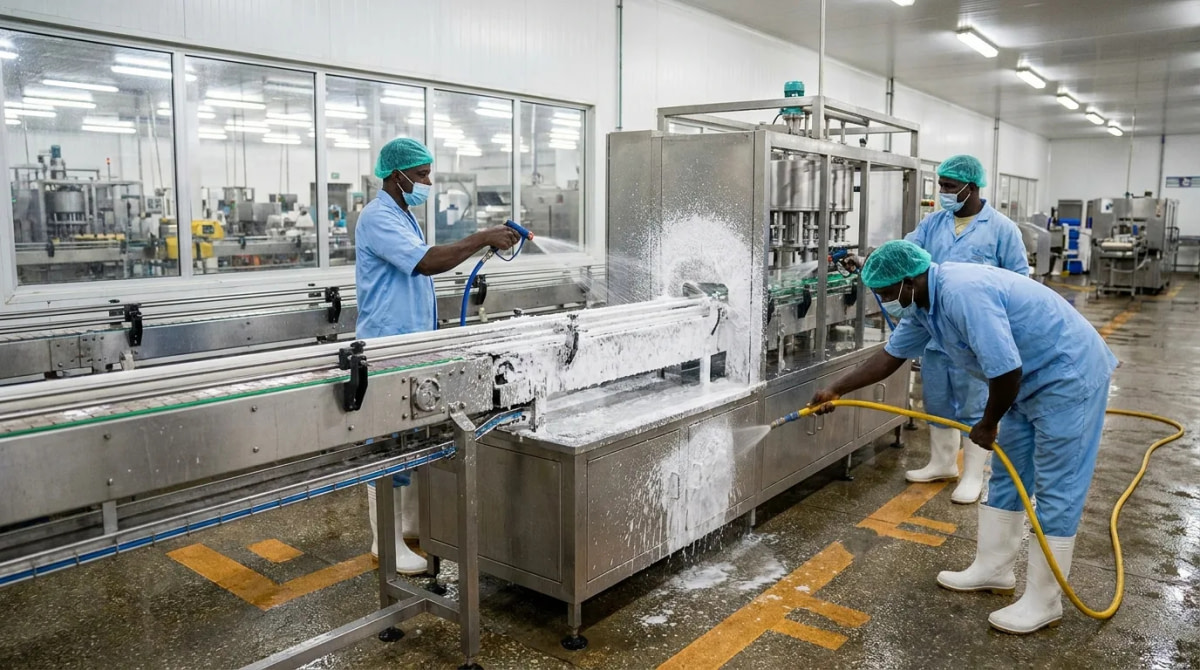
A textbook food cleaning cycle follows seven sequential steps, often summarised as the "wet cleaning sequence":
-
Dry pick-up: remove residues, packaging, product debris.
-
Pre-rinse: warm water rinse to flush bulk soil.
-
Detergent application: foam or gel alkaline cleaner applied at validated concentration.
-
Manual or mechanical scrubbing: contact time and mechanical action to lift adhered soil.
-
Intermediate rinse: potable water to remove detergent residues.
-
Sanitization: chemical or thermal sanitizer at validated concentration and contact time.
-
Final rinse and inspection: where required, followed by visual check and instrumented verification.
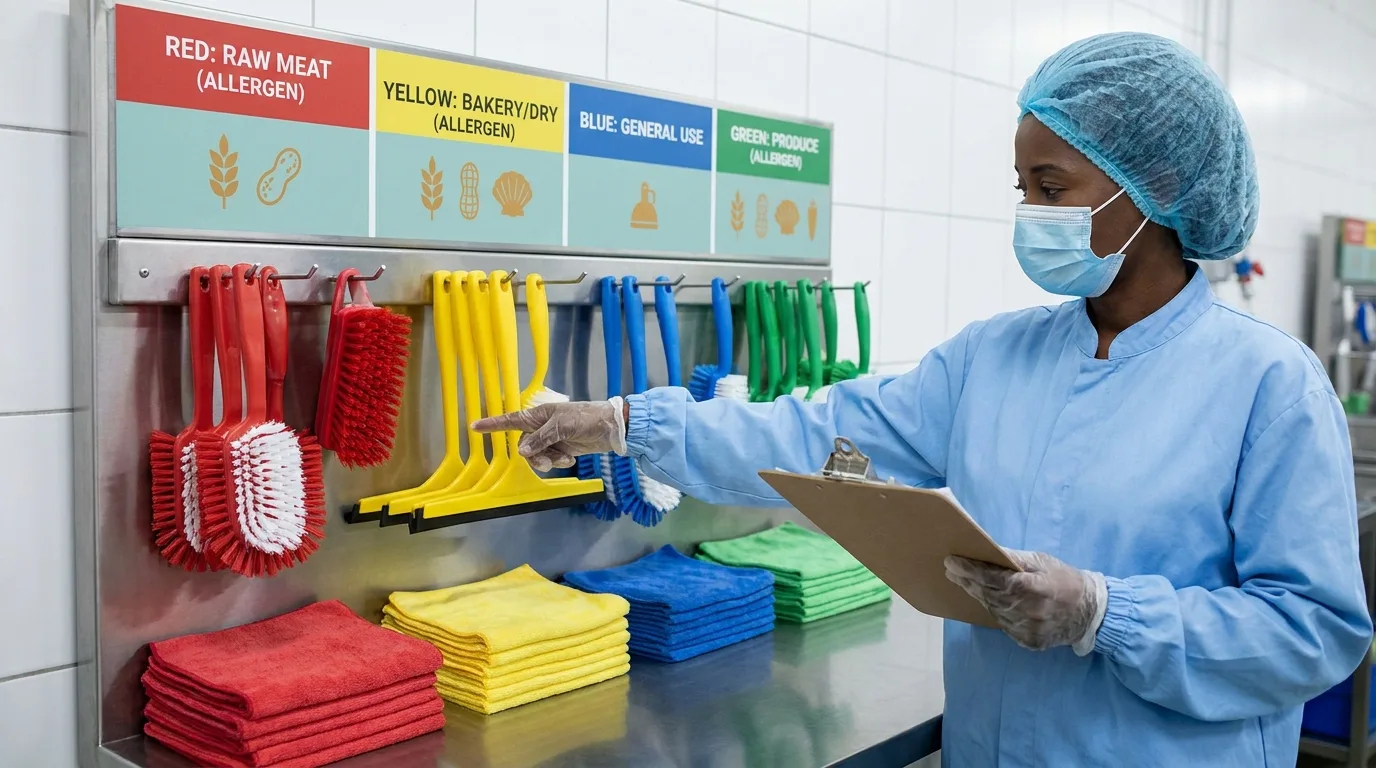
Color-coded tooling is the simplest and most effective allergen segregation control.
Critical zones in a food plant
Direct food contact (slicers, fillers, conveyors, packaging heads). Cleaning frequency is typically post-batch with full disassembly, validated chemicals and post-cleaning verification (visual, ATP).
Equipment exteriors, supports, sensors. Daily cleaning with foam or gel detergents and weekly deep cleaning.
Zone 3 - production environment
Floors, drains, walls in production rooms. Daily cleaning with degreasers and disinfectants, weekly attention to drains.
Zone 4 - non-production areas
Warehouses, corridors, offices. Standard janitorial cleaning, but pest control prevention is critical.
Food-grade cleaning chemicals
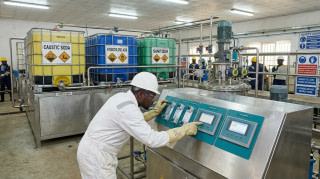
Detergent selection is governed by the nature of the soil and the surface. Alkaline detergents (caustic soda, potassium hydroxide) remove protein and fat. Acid cleaners (nitric, phosphoric, citric) dissolve mineral scale and milkstone. Sanitizers (chlorinated, peracetic acid, quaternary ammonium, hydrogen peroxide) eliminate microbial load. All products must be food-grade, certified by recognised bodies (NSF, Halal where required) and traceable with batch numbers.
CIP (Cleaning in Place) circuits, central to dairies, breweries and beverage plants, automate the alternance of detergent and acid washes under controlled flow, temperature and time. The chemistry behind these cycles is detailed in our industrial chemical cleaning guide.
The master sanitation schedule
A robust master sanitation schedule (MSS) catalogues every cleaning task in the plant, its frequency, the responsible operator, the chemicals to use and the verification method. It is the auditable backbone of any food safety system.
| Area / equipment |
Frequency |
Chemistry |
Verification |
| Fillers, capsulers, conveyors (Zone 1) |
Post-batch |
Alkaline + sanitizer |
Visual + ATP + occasional swab |
| Pasteurizer, mixer, CIP loops |
Daily |
Caustic + nitric acid CIP cycle |
Conductivity + temperature + microbiological |
| Floors and drains |
Daily |
Degreaser + chlorinated sanitizer |
Visual + weekly microbiological |
| Walls, supports, sensors (Zone 2) |
Daily / weekly |
Foam detergent |
Visual |
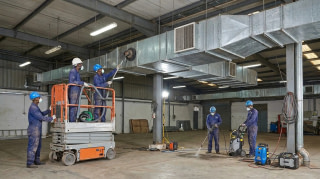
| Ceiling, ducts, light fittings |
Monthly to quarterly |
Foam or wipe-down with quat ammonium |
Visual |
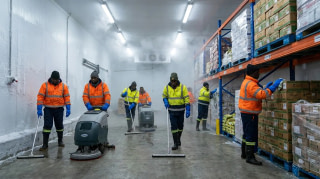
| Cold rooms, freezers |
Weekly to monthly |
Low-temperature foam detergent |
Visual + microbiological |
Allergen management
Allergen cross-contact (peanut, milk, soy, sesame, gluten, egg) is the single most aggressive recall trigger in the food industry. Effective allergen management combines four practices: physical segregation, dedicated runs in time, validated changeover cleaning between products, and analytical verification (allergen-specific lateral flow or ELISA tests). Color-coded tools, signage and operator training reinforce the segregation.
Verification: visual, ATP, microbiological
A clean surface that is not verified is not clean. Three layers of verification work together. Visual inspection catches gross failures and is the entry-level check. ATP bioluminescence delivers a rapid quantitative reading in 15 seconds, with a typical pass threshold below 100 to 200 RLU on food contact surfaces. Microbiological tests (Total Viable Count, Listeria, Salmonella, E. coli, yeasts and moulds) are slower but conclusive and remain mandatory periodic checks.
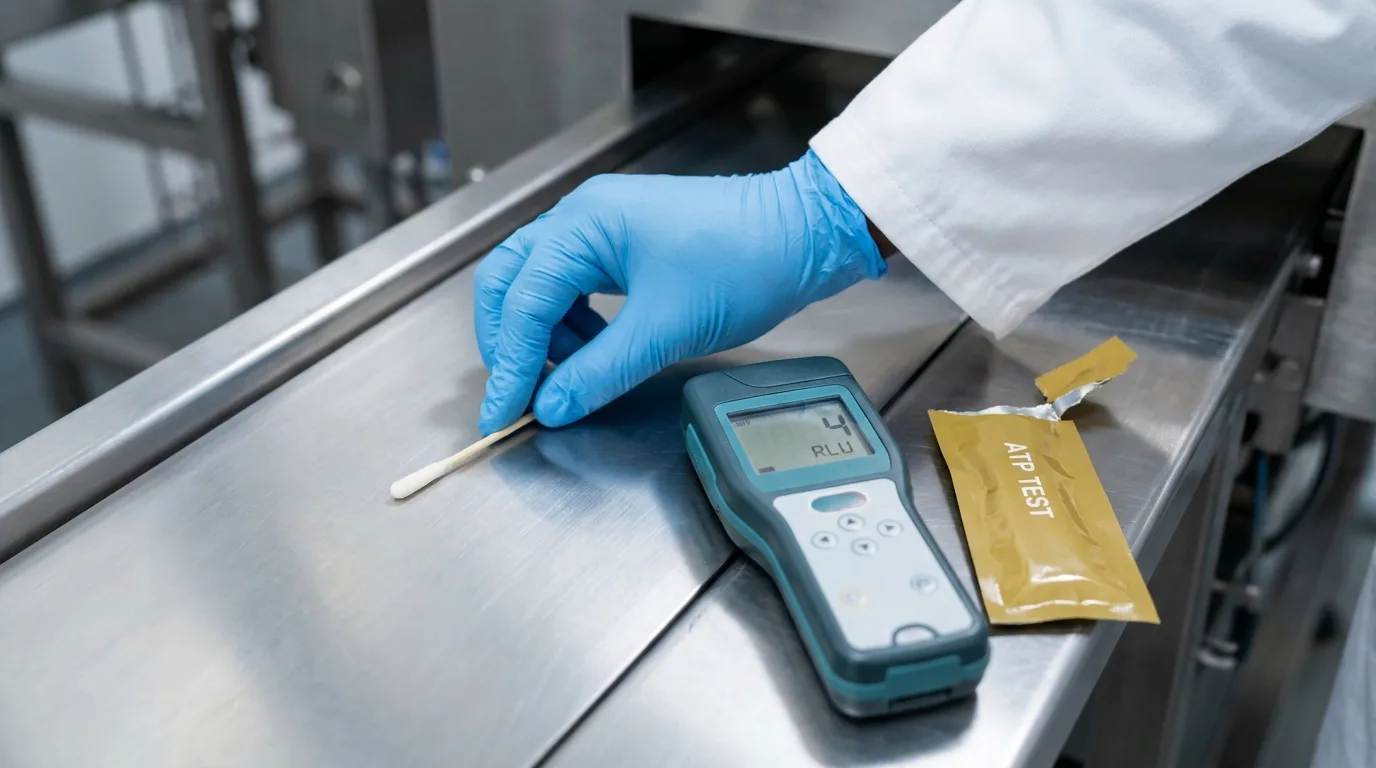
ATP bioluminescence gives a rapid, quantitative verification of cleaning effectiveness on food contact surfaces.
Sustainability and water stewardship
Food plants are heavy water and chemical users. Closed-loop CIP, water recovery for non-critical uses, low-temperature cleaning, enzymatic pre-cleaning and biodegradable detergents are the levers used by the most advanced operators across Africa. These approaches and their ESG implications are explored in sustainable industrial cleaning .
Common mistakes that destroy a sanitation programme
-
Wrong chemistry on wrong soil: acid on protein, alkaline on scale - both make the situation worse.
-
Insufficient contact time: shortening cleaning to gain production time eliminates the action of the chemistry.
-
Skipping the intermediate rinse: detergent residues neutralise the sanitizer.
-
Reusing single-use materials: scrubs, brushes and microfibers must be replaced on schedule and color-coded.
-
No verification, no records: an undocumented cleaning is not a cleaning at all in front of an auditor.
Frequently asked questions
Are food industry cleaning chemicals different from household products?
Yes. Food-grade chemicals are certified by recognised bodies (NSF H1/H2/H3, EcoLab, JohnsonDiversey), come with full traceability and detailed MSDS, and are formulated to leave no toxic residue. Household products lack this certification chain and are not authorised on food contact surfaces.
Most food plants test 10 to 20 critical food contact points after each cleaning cycle. The frequency increases on high-risk lines (RTE - ready to eat, dairy, infant nutrition) and decreases on lower-risk lines (dry foods, sealed packaging).
Is CIP cleaning mandatory in all food plants?
No. CIP becomes mandatory for closed circuits (dairies, breweries, beverages, sauces) where manual disassembly is impractical. Open equipment can be cleaned by foam application, manual scrubbing or COP (cleaning out of place) in dedicated stations.
Can a food plant share cleaning equipment between allergen and non-allergen production?
Strict best practice forbids it. Dedicated tools, color-coded by allergen profile, must be stored separately. If shared equipment is unavoidable, full validated cleaning between productions, plus allergen testing, becomes mandatory.
How do I choose a contractor for food plant cleaning?
Look for HACCP-trained operators, valid food safety certifications, references in your specific sub-sector (beverages, dairy, bakery, meat), capacity to produce a documented protocol, validated chemistry, color-coded tooling and a measurable KPI framework (ATP, swab, recall rate). Read our pillar guide on industrial cleaning services for the full provider selection checklist.