When water and chemicals are out of the picture, the choice often comes down to two dry, mechanical methods: dry ice blasting and abrasive blasting. The first uses CO2 pellets that sublimate on impact, leaving no secondary waste. The second uses abrasive media (garnet, sand, soda, walnut shell) to scour the surface. Both are essential tools in African workshops, refineries, mines and food plants, but they fit very different jobs. This guide compares them side by side.
Key takeaways
- Dry ice blasting (CO2 cleaning) uses solid carbon dioxide pellets at minus 78°C that sublimate on impact, leaving the surface dry and producing no secondary waste beyond the contaminant itself.
- Abrasive blasting projects garnet, soda, glass bead, walnut shell or steel grit at high velocity, removing coatings and corrosion through controlled abrasion. It is the global standard for surface preparation before painting.
- The right method depends on the substrate, the deposit and the operational constraints: dry ice for delicate equipment, food contact and live electricals; abrasive for heavy rust, structural steel and protective coatings.
- Both methods are non-destructive when used correctly and align with the move toward dust-free, water-free industrial cleaning highlighted in modern ESG programmes.
Why compare dry ice and abrasive cleaning?
Both methods belong to the dry mechanical family of industrial cleaning services . They are often considered together because they address similar problems - removing deposits, coatings or corrosion without using water or chemicals - but in radically different ways. Confusing the two leads to bad decisions: choosing dry ice on heavy rust (it will fail) or sandblasting on a food-grade conveyor (it will contaminate everything).
Dry ice blasting: principle and how it works
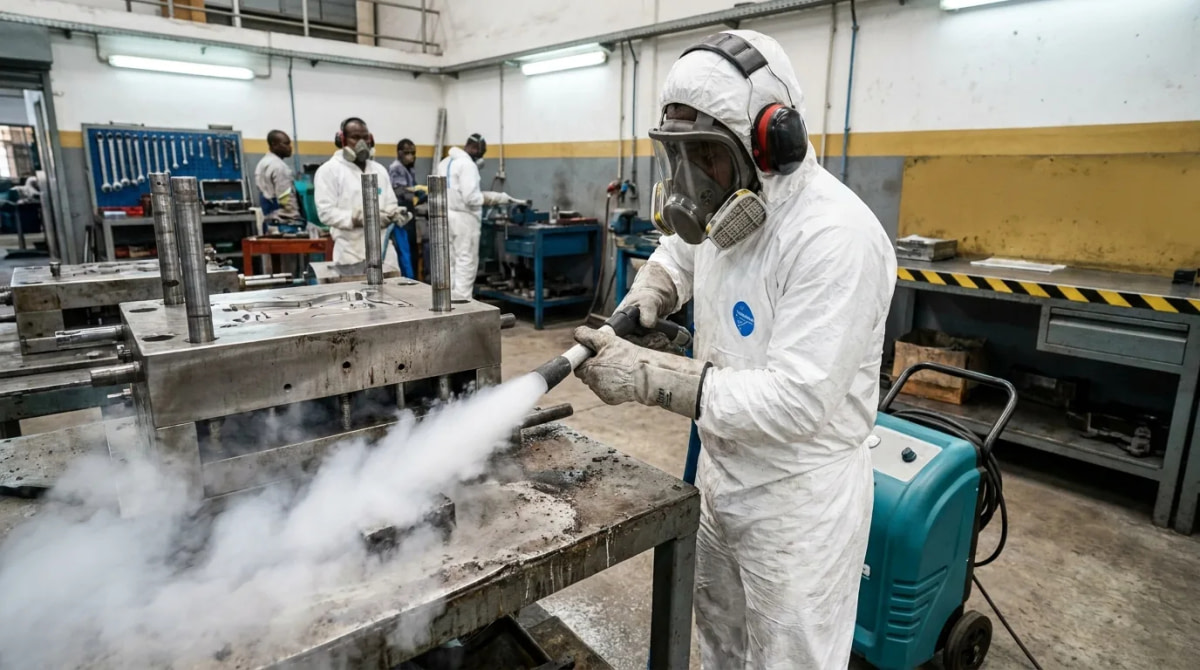
Dry ice blasting projects solid CO2 pellets, typically 3 mm rice-sized, at velocities of 100 to 300 m/s using compressed air. Three physical effects combine on impact: thermal shock (the surface temperature drops, the contaminant becomes brittle), kinetic impact (the pellet detaches the contaminant) and sublimation expansion (the CO2 turns into gas with a volume increase of around 700 times, lifting the contaminant off the surface). The CO2 vanishes as gas, leaving no secondary waste.
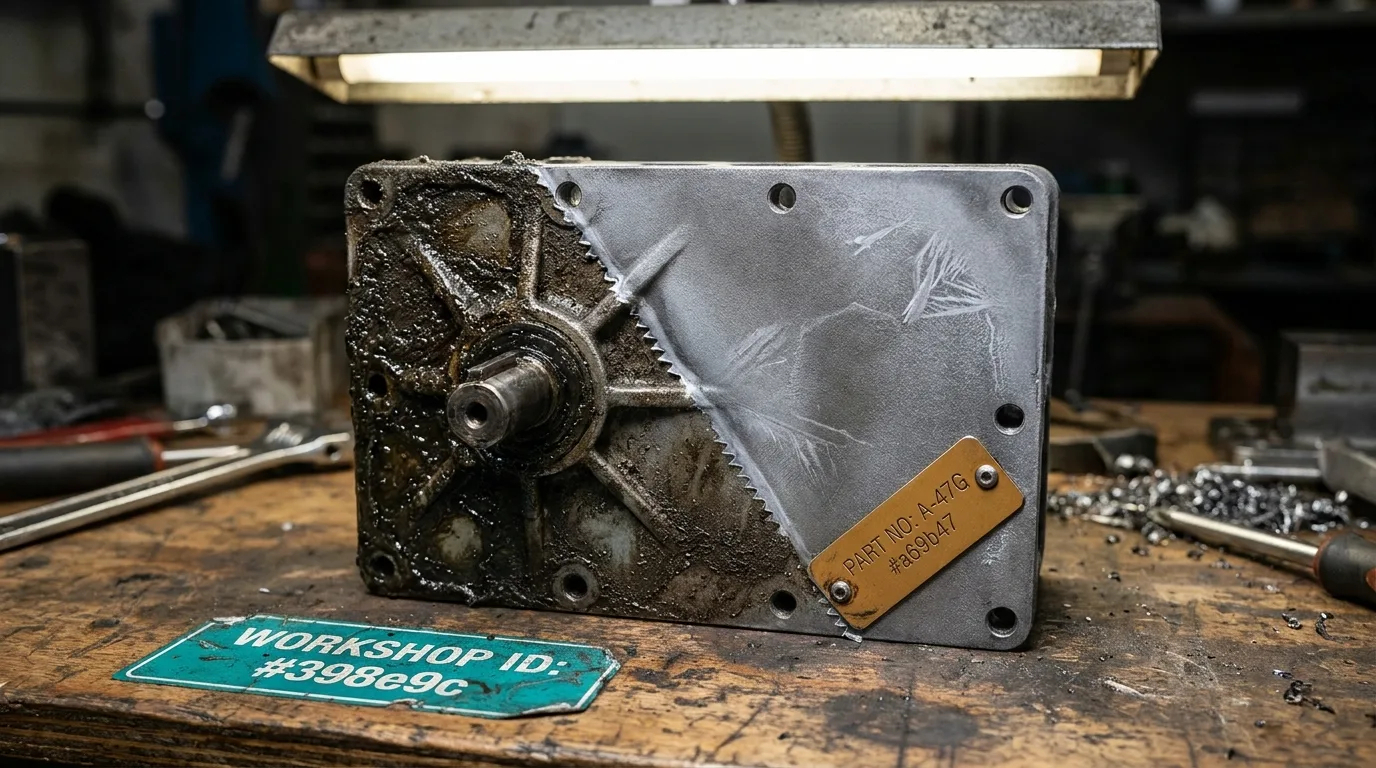
Dry ice blasting removes grease and grime in seconds while leaving the substrate dry and untouched.
Typical dry ice applications include cleaning injection moulds without disassembly, food production lines without water ingress, electrical cabinets without isolation, generators and transformers in maintenance, and historical restoration where the substrate must remain intact.
Abrasive blasting: principle and main media
Abrasive blasting uses compressed air or water to project granular media against a surface. The abrasion removes paint, rust, mill scale and contaminants while creating the surface profile required for coating adhesion. The choice of media defines the result.
-
Garnet: hard, low-dust, recyclable, the favourite of marine and refinery surface preparation.
-
Steel grit and shot: extremely aggressive, used in shipyards and structural fabrication.
-
Glass bead: fine, low aggression, for cosmetic finishes and gentle stripping.
-
Aluminium oxide: long-lasting, sharp, used on tooling and aerospace parts.
-
Sodium bicarbonate (soda blasting): very soft, water-soluble, food-safe, ideal for moulds, fire damage and graffiti.
-
Walnut shell, corn cob: biodegradable, non-aggressive, for sensitive surfaces.
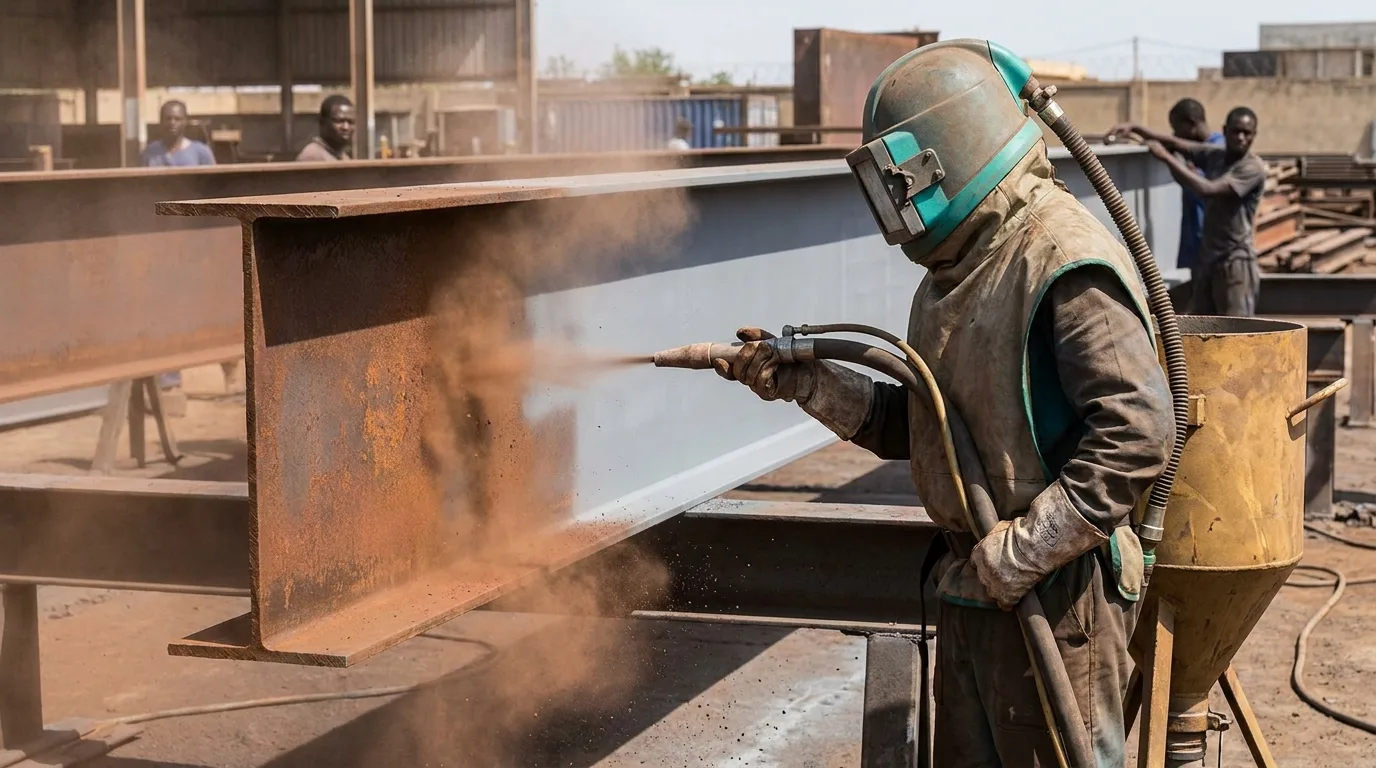
Abrasive blasting remains the standard for heavy surface preparation before industrial coating.
Side-by-side comparison
| Criterion |
Dry ice blasting |
Abrasive blasting (garnet, soda, grit) |
| Action on substrate |
Non-abrasive (no surface profile change) |
Abrasive (creates surface profile, removes substrate) |
| Secondary waste |
Only the contaminant (CO2 sublimates) |
Spent media + contaminant, must be collected and disposed |
| Best for |
Grease, oil, light coatings, moulds, electronics |
Heavy rust, paint, mill scale, structural steel |
| Substrate compatibility |
All hard surfaces, including delicate |
Hard surfaces; risk of damage on aluminium, plastic |
| Live electrical equipment |
Compatible (non-conductive, dry) |
Generally not compatible |
| Operator PPE |
Ear protection, eye protection, insulated gloves, respirator |
Full sandblasting suit, breathing line, ear protection |
| Indicative cost per hour (Nigeria 2026) |
NGN 80,000 to 200,000 per crew-hour |
NGN 50,000 to 150,000 per crew-hour |
| Capex for in-house setup |
Higher (compressor + dry ice machine, NGN 20 to 60 MFCFA setup) |
Moderate (compressor + pot blaster, NGN 5 to 30 MFCFA setup) |
Industrial applications
Dry ice in food, pharma and electrical environments
Dry ice is the method of choice when water and abrasive media are forbidden. In food plants, it cleans conveyors, ovens and packaging machinery without water ingress or microbial risk. In pharma, dry ice cleans tablet presses, capsule machines and compression rolls between batches. In power and industry, dry ice cleans live electrical cabinets, motor windings, transformers and generators during maintenance windows that do not allow water.
Abrasive blasting in heavy industry, marine and oil and gas
Abrasive blasting dominates surface preparation before painting on structural steel, pipelines, storage tanks, ship hulls, offshore platforms and refinery vessels. NACE and SSPC standards (SP6, SP10) define the cleanliness required for each coating system. Soda blasting and walnut shell blasting cover the niches where steel grit would damage the substrate.
Both methods complement hydroblasting
On many industrial campaigns, the right answer is not one method but a combination. Heavy rust on a ship hull may need abrasive blasting after industrial hydroblasting to remove loose scale first. A mould restoration may need soda blasting followed by dry ice for the final detail work. Real-world programmes are method-agnostic and outcome-driven.
Equipment and infrastructure requirements
Dry ice blasting requires a dry ice machine (single or two-hose), a high-volume air compressor (typically 4 to 12 m3/min at 7 to 16 bar) and a regular supply of CO2 pellets. Larger projects benefit from on-site pellet production. Abrasive blasting requires a similar compressor, a pressurised blast pot, a delivery hose, a venturi nozzle and a media supply chain. Recycling units (for garnet, steel grit) lower the operating cost considerably on long campaigns.
Safety and environmental considerations
Both methods generate intense noise (over 100 dB), require strict PPE and dedicated exclusion zones. Dry ice carries additional risks: CO2 displaces oxygen, so confined spaces require ventilation and oxygen monitoring; pellets at minus 78°C can cause cold burns. Abrasive blasting generates fine respirable dust that requires HEPA-equipped extraction and respiratory protection - silica-bearing sand is banned in many jurisdictions in favour of safer media.
Cost considerations
Dry ice is the more expensive consumable: rice pellets typically cost 1,500 to 3,500 NGN per kg in Nigeria, with a single job consuming 50 to 500 kg. Abrasive media is cheaper but generates spent media that must be handled and disposed. The total cost of ownership often tips in favour of dry ice on light, recurring jobs (food production, pharma changeovers) and in favour of abrasive on heavy, one-shot campaigns (structural steel, marine).
Sustainability angle
Both methods score well on the water-saving front and require no chemicals. Dry ice scores particularly well: CO2 used is typically captured from industrial processes, the sublimated gas does not add to the carbon footprint (it would have been emitted anyway), and there is no secondary waste. Abrasive blasting is moving toward recyclable media (steel grit, garnet) to reduce waste, away from silica sand for health reasons, and toward biodegradable media (walnut shell, corn cob) where finish allows. The broader sustainability framework is covered in sustainable industrial cleaning .
Frequently asked questions
Can dry ice blasting damage delicate surfaces?
No, when used correctly. Dry ice is non-abrasive: it does not change the surface profile or remove substrate material. It is widely used on electronics, soft alloys, painted surfaces (when paint must be preserved), historical artefacts and food-grade equipment.
Is sandblasting still legal in Nigeria, Ghana, Kenya and South Africa?
Silica sand is restricted or banned in many industries because of silicosis risk, even though enforcement varies. Most professional contractors have switched to garnet, steel grit, copper slag or aluminium oxide. Confirm the regulatory status with NESREA, EPA, NEMA or DEFF before specifying silica sand.
Which method should I choose for cleaning my injection moulds?
Dry ice blasting on hot moulds in-place is the global standard. It cleans the mould without disassembly, without water and without abrasion, allowing the press to resume production within minutes. Soda blasting is a viable alternative for cold offline cleaning when dry ice equipment is not available.
Can I rent dry ice or abrasive blasting equipment in Africa?
Yes. Specialised contractors in Lagos, Accra, Nairobi and Johannesburg rent units on a daily basis, often bundled with operators because of the training requirement. Long-term contracts with monthly retainer pricing are common for plants with recurring needs.
Where does this method fit in a wider cleaning programme?
Dry ice and abrasive blasting are two of the five method families. Their best uses, limits and combinations are detailed in our industrial cleaning services pillar guide , which covers the full panorama.